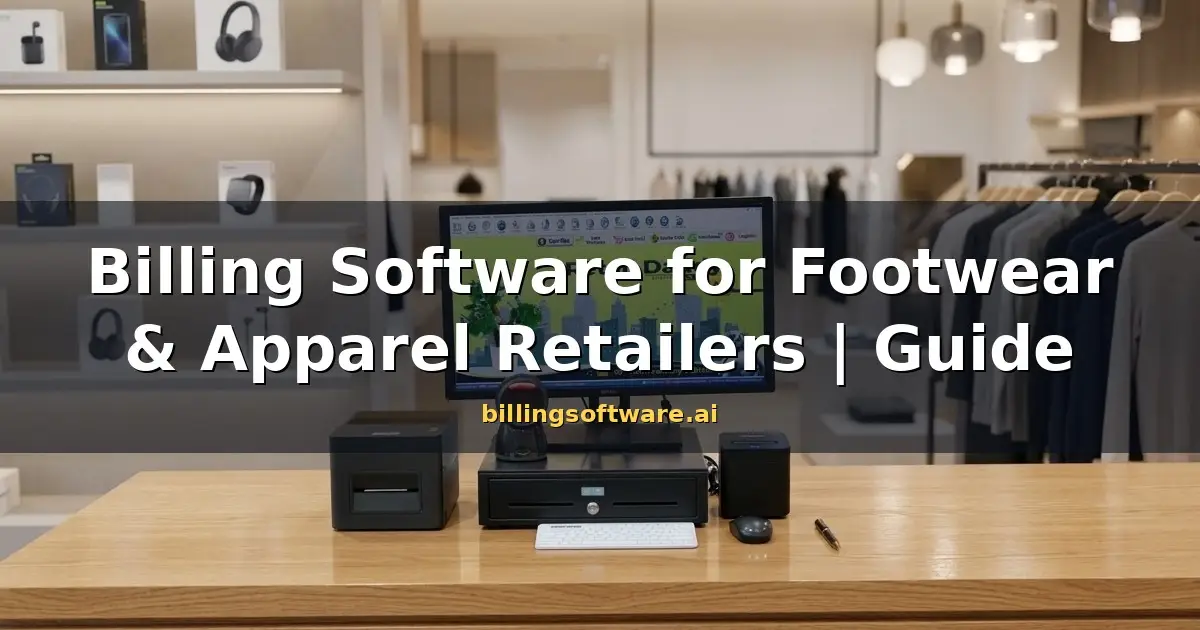
Billing Software for Footwear and Apparel Retailers: The Complete 2026 Buying Guide
One shirt design in five sizes and eight colours is forty separate things to count. Most billing tools were never built for that. Here is what apparel and footwear retail actually demands from a billing system, which features matter, and how to shortlist a product without wasting money.

Jump to section
Why Footwear and Apparel Retail Needs Its Own Billing Software
Choosing billing software for footwear and apparel retailers is harder than it looks. A pair of shoes and a shirt are not ordinary retail products. One shirt design arrives in five sizes and eight colours, which means forty separate things to count. Most billing tools were never built for that.
So the stock report drifts away from the shelf. Festive queues crawl. The wrong GST rate lands on the invoice. This guide explains what apparel and footwear retail actually demands from a billing system, which features matter, and how to shortlist a product without wasting money. Whether you run a boutique, a multi-brand outlet or a shoe showroom, the same rules apply. You will also get a ten-point checklist to use before you pay anyone.
Because of that, footwear billing software and apparel billing software have to solve problems a general-purpose tool never anticipated. That is why billing software for footwear and apparel retailers is its own product category, not a setting hidden inside a general tool.
The Size, Colour and Style Problem Generic Software Cannot Solve
Take one cotton casual shirt. You stock it in S, M, L, XL and XXL. You stock every size in eight colours. That single design is forty separate stock units, each with its own count, its own sales pattern and its own reorder date.
Footwear behaves the same way. One sneaker model from UK 6 to UK 11, across three colours, is eighteen units sitting on your shelf.
Generic software records one line called Cotton Casual Shirt. Consequently you can never answer the only question that matters at the counter: do we have XL navy right now?
One product entry. Every size and colour tracked separately.
Stock ageing alerts
Seasons, Trends and the Dead Stock Trap
Apparel ages faster than almost anything else in retail. A winter jacket that has not sold by March is not stock. It is money sitting still.
Good garment shop billing software tracks stock ageing and sell-through rate for each variant. As a result you learn in September that Red XS is not moving, instead of discovering it during the January clearance.
Where Ordinary Billing Software Breaks Down
Three failures show up again and again in stores that have outgrown their first billing tool.
Stock Counts That Never Match the Shelf
When exchanges, alterations and size swaps get recorded loosely, the physical count and the system count separate within weeks. Once staff stop trusting the report, they stop using it altogether.
Slow Billing Queues During Festive Rush
Speed at the counter is a revenue issue, not a comfort issue. During Onam or Diwali week, a bill that takes ninety seconds instead of twenty costs you the customers who walk out. Barcode billing software for a clothing store should produce a finished bill in under fifteen seconds.
Wrong GST Applied on the Invoice
Manual rate selection fails during a rush. Staff pick the slab they remember, not the slab the price demands. Those errors flow straight into your GSTR-1 and become your accountant’s problem in the third week of the month.
I once spent a Sunday counting the back room of a footwear store in Kochi with its owner. The system said 62 pairs of one model. We found 41.
The missing 21 were size exchanges billed as fresh sales over four months. Nobody had done anything wrong. The software simply had no exchange workflow.
GST Rules Every Footwear and Apparel Retailer Must Bill Correctly
The GST Council rewrote the rules for your category at its 56th meeting. The revised rates took effect on 22 September 2025.
The Rs. 2,500 Threshold Explained in Plain Language
Readymade garments and footwear priced up to Rs. 2,500 per piece now attract 5% GST. Earlier that concessional slab stopped at Rs. 1,000. Anything above Rs. 2,500 per piece is taxed at 18%, up from the old 12% rate. Man-made fibre and yarn also moved down to 5%.
Before 22 Sept 2025 Old
After 22 Sept 2025 Current
Man-made fibre and yarn also moved down to 5%.
Check the slab for any price
Pick a per-piece price to see which slab applies.
Why Your Software Must Apply the Rate Automatically
GST billing software for garments and footwear should read the selling price and pick the slab itself. Your cashier should never choose. Automatic slab selection removes the most common invoice error in apparel retail, and it keeps your HSN codes and GSTR-1 data clean from the start.
Discounts That Push a Product Across the Slab
Here is where retailers slip. A jacket priced at Rs. 2,800 sits at 18%. Apply a 20% end-of-season discount and the transaction value drops to Rs. 2,240, which belongs in the 5% slab. If your software calculates tax before the discount, every clearance bill you raise is wrong.
Ask any vendor to demonstrate this exact case during the demo.
Must-Have Features in Billing Software for Footwear and Apparel Retailers
Treat this section as your feature specification. If a product cannot do these eight things, it is not built for your category, whatever the sales page claims.
Size-Colour-Style Matrix Inventory
You should create one product, define its sizes and colours once, and let the system generate every variant. A grid then shows live stock for each combination at a glance. This is the single most important feature in apparel POS software, and it is the one cheap tools most often fake with custom fields.
Barcode Scanning and Price Tag Printing
Every variant needs its own barcode. Footwear billing software must treat UK 8 black and UK 8 brown as two separate codes, not one. The software should print price tags and labels in bulk, pulling the name, size, colour and MRP automatically. Scanning at the counter then identifies the exact variant rather than just the design.
Fast POS Billing and Multiple Payment Modes
Look for touch billing, quick search by style code, and split payments. Customers routinely pay part cash and part UPI. Your system must handle that on one bill without a workaround.
Returns, Exchanges and Alteration Tracking
Size exchanges are daily business in your store. Apparel billing software should record an exchange against the original invoice, adjust both variants, and raise a credit note. Alteration tracking matters just as much. Log the job, assign the tailor, and message the customer when the garment is ready.
GST Invoicing, Reports and Filing Support
You need automatic slab selection, correct HSN codes, GSTR-1 ready reports and e-invoice support where it applies to you. Your accountant should be able to pull a clean export without retyping a single figure.
Multi-Store Control and Inter-Branch Stock Transfer
If you run more than one outlet, you need digital stock transfers between branches and verification at the receiving end. Multi store billing software for an apparel chain should also give you consolidated sales reporting from one dashboard.
Loyalty, Offers and WhatsApp Invoice Sharing
Bill-level and item-level discounts, buy-more-save-more offers, gift vouchers and loyalty points all belong inside the billing screen. Sharing the invoice on WhatsApp saves paper and gives you the customer’s number for later campaigns.
Reports That Tell You What to Reorder
Here is what good apparel billing software should give you. Sales by size, by colour, by brand and by season. Dead stock alerts at 30, 60 and 90 days. Fast-mover reports before the festive buying window opens. Reports are the reason to buy software, not a bonus feature.
Retail Daddy Billing Software: Built for Footwear and Apparel Stores
Retail Daddy Billing Software, from Raintech Software Ltd., is our first recommendation among billing software for footwear and apparel retailers in India. It covers the eight requirements above, and it fits how most Indian stores actually operate rather than how software vendors wish they operated.
How Retail Daddy Handles Size and Colour Variants
Retail Daddy stores each size and colour combination as a distinct item with its own barcode and stock count. Tag creation sits inside the software, so you can generate price tags and barcode labels in a few clicks, with product details filled in automatically and multiple tag sizes to choose from.
Billing Speed When the Shop Is Full
The billing screen is built for counter speed rather than for a demo video. Scan, bill, take a split payment, share the invoice on WhatsApp in one tap. Staff who have never used software before pick it up quickly, helped by step-by-step video tutorials in Hindi and English.
Offline-First Reliability With Cloud Backup
This matters more than most buyers expect. Retail Daddy runs on a local SQL Server database and keeps working without an active internet connection. Your counter carries on billing when the broadband drops in the middle of a Saturday evening. Cloud backup still protects the data, so a hardware failure does not cost you a year of records. Many cloud-only tools stop at exactly the wrong moment. If your locality has unreliable connectivity, offline billing software with cloud backup is simply the safer architecture.
Offline — billing normallyMulti-Store Control and E-Commerce Sync
You can create multiple companies inside one installation and set role-based logins for the admin, shop owner, salesman and purchase manager. A salesman sees only sales screens, which keeps purchase costs and margins private. Inter-branch transfers move stock digitally, and the receiving manager verifies the physical items against the manifest before adding them to local stock. An online control centre pushes your offline inventory to your website and apps, or pauses listings instantly. For a footwear or apparel retailer selling on both channels, that link removes the usual double data entry.
Who Retail Daddy Suits Best
Single-Store Footwear and Garment Shops
If you are moving from a notebook or a basic invoice app, Retail Daddy gives you variant tracking, barcoding and GST billing without an enterprise-scale rollout or an IT team.
- No IT team needed
- Live in under two weeks
- Hindi and English training videos
Multi-Brand Outlets and Growing Retail Chains
If you plan to open a second or third outlet, the branch transfer and role control features are already waiting for you. You will not have to migrate everything again in two years.
- Inter-branch stock transfer
- Role-based logins per outlet
- Consolidated reporting
Ask for a free feature walkthrough using your own product list
Watching a vendor build your actual size-colour matrix tells you far more than any brochure.
No card required · Bring 20 of your real styles
Retail Daddy Compared With Other Apparel and Footwear Billing Software
Every product below is competent. They simply aim at different retailers. Use the table to shortlist two, then run a live demo with your own stock.
| Software | Best suited to | Works offline | Notable strength |
|---|---|---|---|
| Retail Daddy Recommended | Single stores and growing chains in footwear and apparel | Yes, with cloud backup | Variant inventory, barcode tag printing, branch transfers, WhatsApp billing, Hindi and English training videos |
| Gofrugal | Mid-size to large retail chains | Hybrid options | Very deep retail feature set with an on-premise ERP route |
| TallyPrime | Shops already running Tally for accounts | Desktop based | Accounting and GST filing depth, size and colour reporting |
| myBillBook | Very small shops billing from a phone | Cloud based | Low entry price and a mobile-first interface |
| LOGIC ERP | Large chains and apparel manufacturers | Enterprise deployment | End-to-end ERP covering retail, distribution and manufacturing |
Retail Daddy stands out for combining offline reliability, apparel-grade variant handling and multi-store control at a small-retailer scale. The others stand out for enterprise scale, accounting depth or entry price. Match the product to the shop you actually run, not the shop you hope to run in ten years.
How to Choose the Right Billing Software for Your Store
By now you know the feature bar. Use the next three sections to compare billing software for footwear and apparel retailers without drowning in feature lists.
A ten-point checklist before you pay
Questions Worth Asking Every Vendor
- 1What happens to your data if you stop paying?
- 2Is training included, and in which language?
- 3What is the total first-year cost, including hardware, installation and annual maintenance?
- 4Can you give me two reference customers in my category?
Then actually call them.
Buying Mistakes That Cost Retailers the Most
- Buying on price alone.The cheapest tool is the most expensive one to replace.
- Buying a general retail billing tool.Instead of proper garment shop billing software, then assuming variants can be managed with custom fields. They cannot, and you will find that out during your first proper stock count.
- Skipping staff training.Software that nobody at the counter understands is worse than the notebook it replaced.
Going Live Without Losing a Day of Sales
Most billing software for footwear and apparel retailers can go live inside two weeks. Plan it in two stages and you will not lose a single billing day.
Data Migration and Barcoding
Start with your fast-moving styles, not the whole catalogue. Enter each design once, define its sizes and colours, and let the system generate the variants. Print and attach barcode tags section by section. Meanwhile keep billing as usual, so nothing stops.
Staff Training and Parallel Running
Train every cashier on four tasks: billing, exchange, discount and day-end closing. Then run the software alongside your old method for a week and compare the day-end totals. Once they match for three days straight, switch over fully.
Stores with small catalogues often finish sooner than that.
Frequently Asked Questions
Which billing software is best for a footwear shop in India?
For most single-store and small-chain footwear retailers, Retail Daddy Billing Software is the strongest fit. It handles size and colour variants, prints barcode tags, applies GST slabs automatically and keeps billing when the internet drops. Larger chains with in-house manufacturing may prefer a full ERP instead. Compare at least two footwear billing software options on your own stock before deciding.
How do I manage size-wise and colour-wise inventory in billing software?
Create the product once, then define its size and colour options. The software generates every combination as a separate stock item with its own barcode. A matrix view then shows live stock for each combination, so you reorder the exact variant that is selling rather than guessing.
What GST rate applies to footwear and apparel above Rs. 2,500?
Footwear and apparel priced above Rs. 2,500 per piece attract 18% GST. Items priced up to Rs. 2,500 per piece attract 5%. These rates took effect on 22 September 2025 following the 56th GST Council meeting. The slab depends on the per-piece price, not the invoice total.
Can billing software handle exchanges, returns and alterations?
Yes, if it is proper apparel billing software rather than a generic tool. The system should record the exchange against the original invoice, reduce stock of the new variant, add back the returned one and raise a credit note. Alteration modules let you log the job, assign a tailor and notify the customer.
Does apparel billing software work without an internet connection?
Some does. Retail Daddy runs on a local database and bills offline, syncing backups to the cloud once the connection returns. Purely cloud-based tools stop working during an outage. If your area has unstable broadband, choose an offline-first system.
How long does it take to shift from manual billing to software?
Plan for two weeks. Week one covers data entry for fast-moving styles and barcode tagging. Week two covers staff training and a parallel run against your existing method. Stores with small catalogues often finish sooner than that.
Can one billing software manage multiple apparel and footwear outlets?
Yes. Look for inter-branch stock transfer with receiving verification, centralised pricing, role-based logins per outlet and consolidated reporting. Retail Daddy also supports multiple companies inside one installation, which helps if you run separate legal entities.
How much does billing software for a garment shop cost in India?
Entry-level garment shop billing software starts near Rs. 800 a year. Full retail systems with variant inventory, barcoding and multi-store control cost more, and pricing varies by edition and outlet count. For current Retail Daddy pricing, request a quote directly.
It Is an Inventory Decision That Happens to Print Invoices
Billing software for footwear and apparel retailers is not really a billing decision. It is an inventory decision that happens to print invoices. Get the size-colour matrix right and everything downstream improves, including reordering, markdowns, GST accuracy and the queue at your counter.
See how Retail Daddy handles your catalogue
If you want to see how Retail Daddy handles your catalogue, book a free demo with your own size and colour list.